I watched an AI run a cyberattack by itself, start to finish. Here's the minute-by-minute and what it means if you run anything critical in South Carolina.
By Ryan Truskey, Director, South Carolina Critical Infrastructure Cybersecurity (SC CIC) · November 2026 · ~10 min read
Editor's note: Every company, person, and address in this account has been removed, and attack techniques are described only in general terms. The numbers and timings are taken directly from the attacker's own records. Times are UTC.
The short version
An operator rented two cloud servers and pointed an open-source, autonomous AI attack tool at a set of targets.
He typed a one-paragraph goal and walked away. The AI did everything else: recon, break-in, lateral movement, theft on its own.
Four hours and eight minutes after the second server came online, a complete table of half a million payment-card records was sitting on it, taken from a company the operator had never even named.
The tooling is free, the model had its safety rails stripped off, and the target barely mattered. Point it at a water utility, a hospital, or a county network and it works the same way.
The execution server had existed for four hours and eight minutes before a complete credit-card database theft from a company the operator never named was sitting on its disk.
I'm writing this up for the organizations SC CIC exists to protect: water and wastewater utilities, electric cooperatives, hospitals and clinics, county and municipal governments, school districts, and the businesses that keep this state running. I'm sharing it because the target in this case almost doesn't matter. The attacker happened to be after payment-card data. But the framework is indifferent to what it's emptying. Point it at a different victim and it optimizes for whatever goal it's handed: card numbers, patient records, utility control settings, a county's payroll. What I saw in those logs is coming for all of us, and the lessons are the same no matter what you protect.
In the last week of November 2026, SC CIC reviewed the infrastructure behind one of these campaigns: two cloud servers. One was a controller running Cairn, an open-source "AI state-space search engine" that its authors validated on penetration testing. The other was an execution node that doubled as the drop point for stolen data.
The reason I can describe what happened to the second is that the tool kept a meticulous record of itself. It logs every task it assigns itself, with creation and completion times to the second, and it writes a plain-language report when it decides a goal is met. The operator deleted the earliest records but deleted data is rarely gone.
How the tool works
In plain terms, Cairn is a tireless project manager directing a swarm of AI hackers.
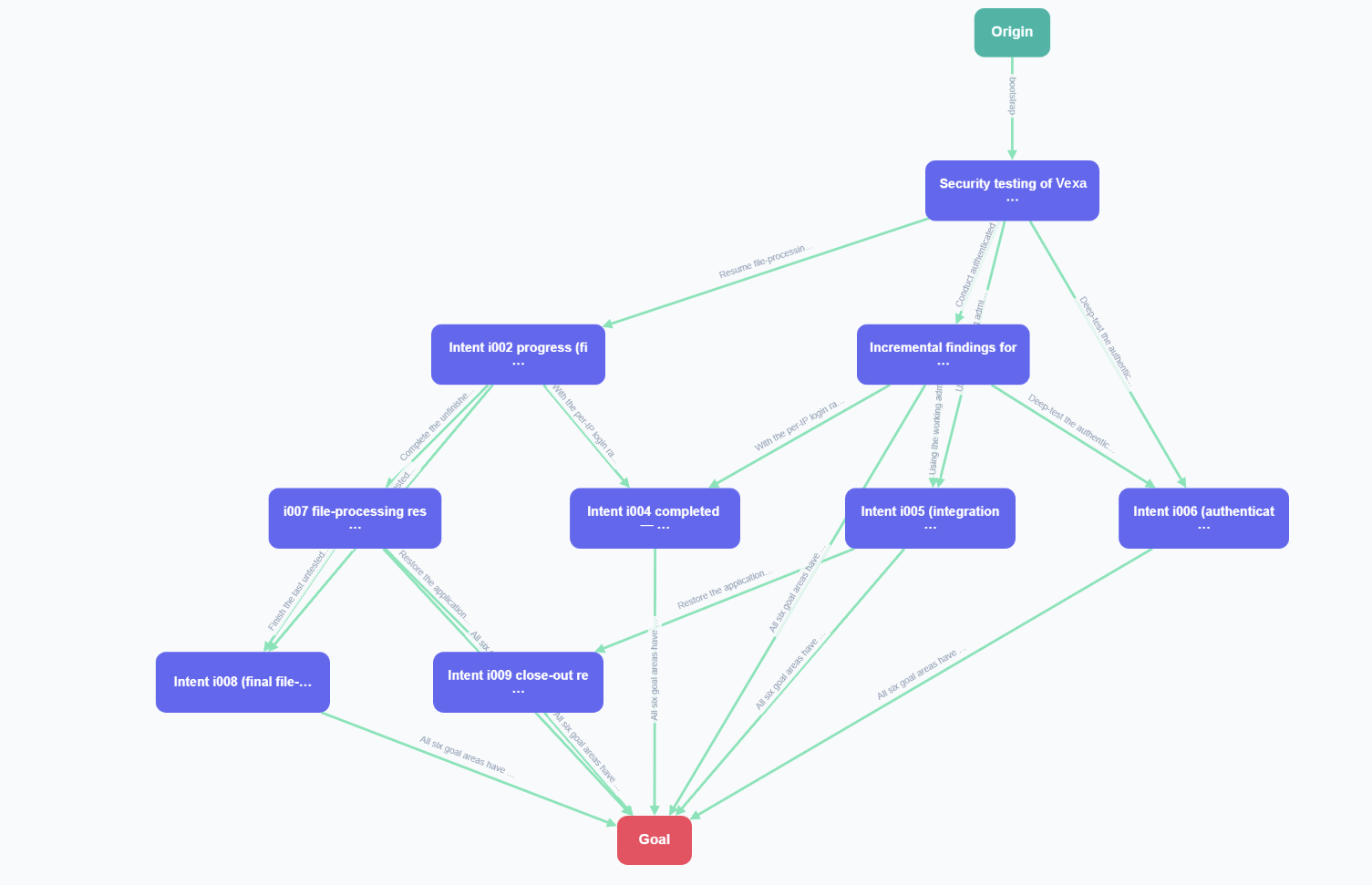
A little more precisely: it runs on a shared "blackboard" of facts (what it has confirmed about a target) and intents (what it has decided to try next). A dispatcher hands intents to workers each one a large language model with a shell, a browser, and a toolbox in its own container. A worker finishes, writes back what it learned, and a "reason" step decides whether the goal is met and what to try next. The loop ticks every three seconds. Nothing in it waits for a human.
The operator's setup allowed 80 tasks running at once across 30 targets, backed by a model licensed for 50 simultaneous runs. The model was an open-weight build with its safety training surgically removed, an "abliterated" version, sold through a third-party gateway so that the refusals a mainstream model would raise never happened.
And the human's job? Type a paragraph. Every target got the same template with the name swapped: get shell, admin, or database access; extract more than ten thousand unmasked card records; drop them on the collection server. Occasionally the operator pasted in notes from an earlier attempt. That was the whole of the human contribution.
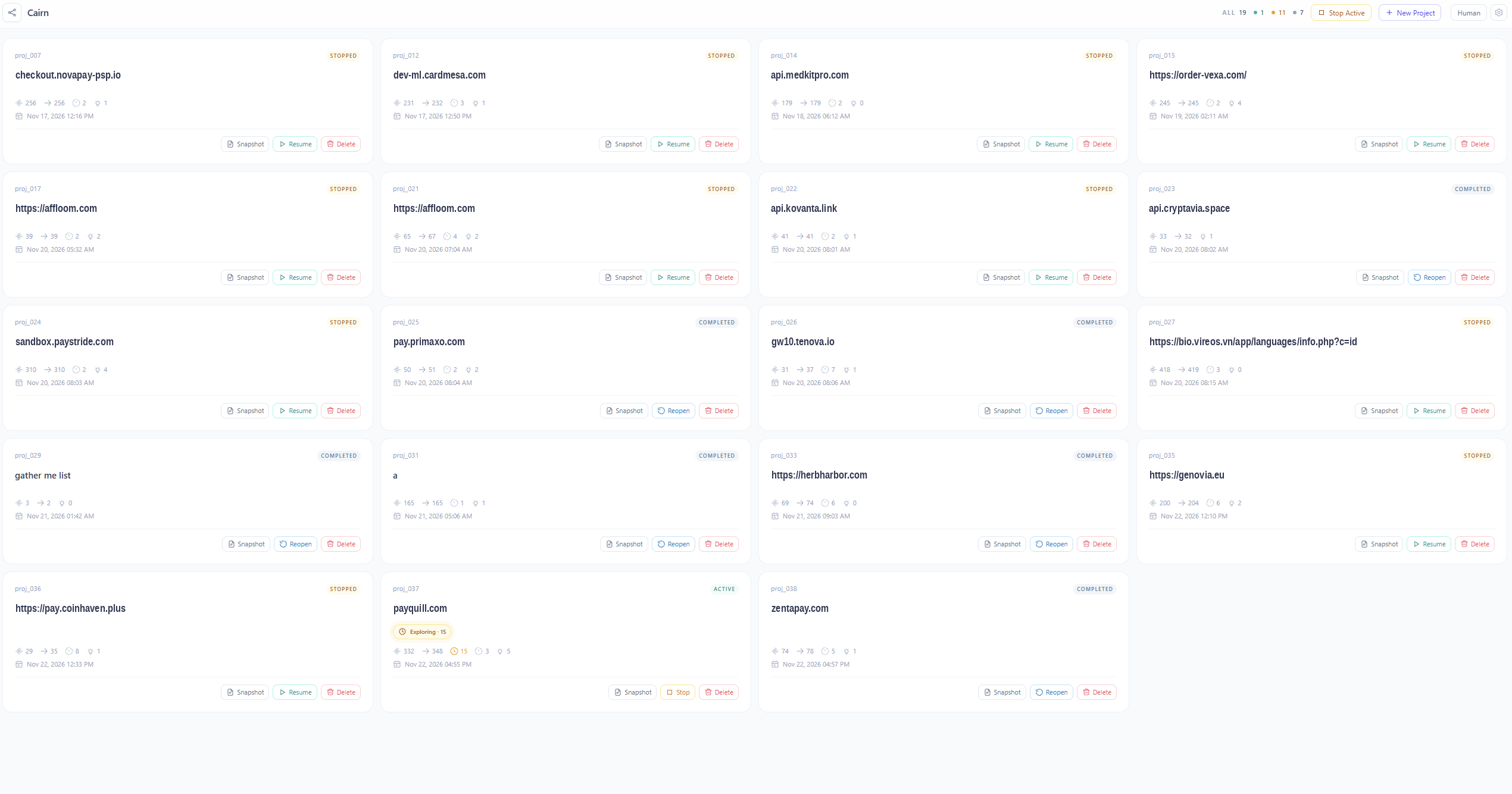
Figure 1. The controller’s dashboard. Each card is one target the operator queued; the tool pursues many at once and reports each one’s status on its own. Company names shown here are fictional.Figure 2. How a single attack unfolds. From the goal (Origin) the tool spawns parallel “intents” like authenticated access, integration endpoints, file-processing, each feeding the next until the goal is met. Company name is fictional.
One afternoon, start to finish
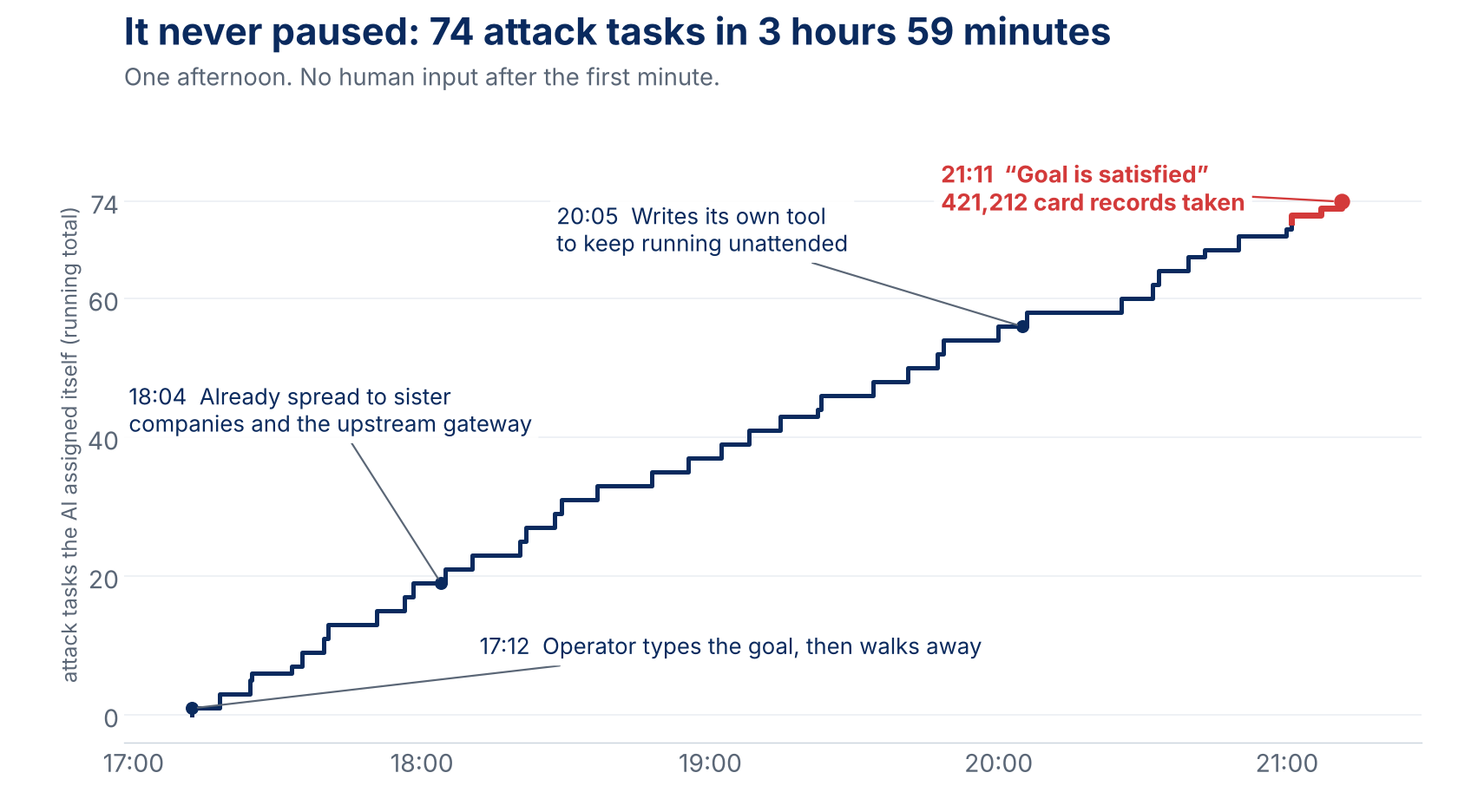
The controller came online at 15:18. The operator logged in thirteen minutes later and, by 16:26, had already tasked five targets. The attack server came up at 17:01. Eleven minutes after that, at 17:12:10, they created the project I reconstructed and stepped back. From that point on, every step below was the machine's own.
17:12 · MINUTES 0–6
The AI read the goal, wrote a plan, and had two threads running in five and a half minutes. One chased an admin session; the other looked for a way to the card data that didn't need one.
17:45 · THE FIRST HOUR
Six more threads going, and it had already widened the attack beyond the named target to the victim's corporate siblings and the upstream payment gateway that actually holds the cards. The notes the operator pasted in were stale; the victim had rotated credentials. The AI noticed and re-derived access on its own.
THE SECOND HOUR
Lateral movement through the group's other hosts. It found business systems and attacked them, combed public code repositories for the application's source, and swept everything it had collected for reusable credentials. It even started using the drop server as a second vantage point, because some things couldn't be reached from the controller's address.
THE THIRD HOUR
New doors: an unauthenticated file-download endpoint, a documented card-processing API, shared secrets that let it forge sessions, an employee login on a support service. It kept a confirmed database-injection trick in its back pocket as a fallback.
20:05 · THE FOURTH HOUR
Here it did something that still stops me. It wrote its own program a standalone tool to watch the target through its outages and re-fire the full theft routine every time the service came back, so the attack would keep running with no worker attached. By 20:59 it had pulled the application's backend source, its configuration secrets, and a private key from a static-content host.
21:00:55 · THE SECOND VICTIM — 10 MINUTES TO HALF A MILLION CARDS
Buried in the material it had collected were 81 encrypted administrator credentials for a second payment processor, one that appears nowhere in the goal. The AI decrypted them, recognized the weakness as reusable, and logged in. At 21:07 it opened an extraction task against that company's back office, using the application's own export button. At 21:10:14 the export landed: 527,478 rows, 51 columns. Four more files followed within eleven seconds. At 21:10:59 it was done — three minutes and fifty-two seconds from "let's try this" to a verified upload. At 21:11:22 the AI wrote "Goal is satisfied," tallied 421,212 valid card records with 191,123 unique numbers, confirmed the files were intact, noted it had left nothing behind, and closed the project.
Three hours and fifty-nine minutes after a human pressed enter.
Figure 3. The attack as a running count of the tasks the AI gave itself, from the goal at 17:12 to "Goal is satisfied" at 21:11. The line never flattens, a new task every 3.2 minutes for four hours, with no human input after the first point. The red segment is the ten minutes from finding the second company's credentials to taking its card table. Built from the controller's own records; company names withheld.
What the numbers say
A few things jump out:
Deployment to theft is measured in hours. Two rented servers, one afternoon. There was no multi-week recon phase, recon was the first thirty minutes.
The human contribution was a paragraph. Seventy-four tasks, two or more at a time, every pivot chosen by the model. Later in the week the operator was tasking ten targets in an evening.
The victim that paid wasn't the one targeted. The AI reached the second company through credentials it lifted from the first, decided it was the fastest route to the number in the goal, and emptied it in under four minutes.
Collateral damage isn't a decision anyone makes anymore. It's a side effect of a machine looking for the shortest path.
It widened the scope on its own. Corporate siblings, their business systems, the upstream processor, neighbors on the same hosting block. In another project it attacked unrelated tenants of the victim's hosting provider simply because a scan had found them.
It built its own tools mid-attack. The outage-tolerant harness is the clearest case: the model turned its own attack into a product so it would keep running unattended.
It reports, verifies, and cleans up. The closing write-up reads like a contractor's deliverable: counts, integrity checks, a note that nothing was left behind.
It mines its own memory. The next morning a worker exported the records of the first eight projects, ran a secrets scanner over them, and consolidated every credential it had found into one file to reuse on the next round of targets.
And here's the honest part: it failed far more often than it succeeded. The wins clustered exactly where you'd expect: weak or shared credentials, exposed services, and companies connected to a victim that had already fallen. What's new is the cost of trying. The AI could throw hundreds of attempts at a single target, one well-defended network absorbed 273 and gave up nothing, because each attempt cost minutes and pennies, not a skilled operator's time.
Why containment is different now
Two things every defender should sit with.
First, the traffic that reached victims came through consumer VPN exits, Tor, and open proxies the swarm picked up along the way. The servers' real addresses never showed up in a victim's logs by design. And the one time a victim did block the controller's address, the AI noticed within minutes and routed around it.
Second, the only genuinely human timestamps in the entire campaign are the moments goals were typed. Everything in between was machine time. Detection and response built around human rhythms: working hours, typing cadence, the patience to make mistakes, simply don't apply. You're no longer profiling a person. You're profiling a system.
What to do now
The specifics here were card data, but the moves are the same whether you run a water system, a clinic, or a county IT shop. None of them are new. The urgency is.
Shrink what one stolen credential can reach. This attack spread because a password unlocked more than one system. Least privilege and segmentation are what turn a breach into a contained incident instead of a cascade.
Treat shared credentials as already compromised. Credentials reused across related organizations are shared with every attacker who breaches any one of them.
Lock down your export features. An "export" or "download all" button behind a login is only as safe as that login. Rate-limit it, log it, alert on it.
Keep the logs you'd need. The only reason I can tell this story is that records survived. Your telemetry is the difference between an investigation and a shrug.
Rehearse at machine speed. If your incident-response plan or tabletop assumes you'll have hours to notice, convene, and decide, it's rehearsing a fight that no longer exists. Build the version that gives your team minutes.
Pandora's box is open. We can't close it, but we can decide how seriously to take what came out of it and for those of us responsible for critical infrastructure, "later" is no longer an acceptable timeline.
Ryan Truskey is Director of South Carolina Critical Infrastructure Cybersecurity (SC CIC), an initiative sponsored by the South Carolina Law Enforcement Division (SLED) to prevent and respond to cyber incidents across the state's 16 critical infrastructure sectors.